What Hearthvyn Is Intended to Do
Hearthvyn is an information-organisation system. Its purpose is to receive information, apply a classification framework to it, and present the results in an ordered, navigable form. The system does not generate information independently — it works with what is provided to it.
Users interact with the system through a structured interface. That interface shows organised records, grouped categories, and available actions. What is visible reflects what the system has been given and how it has classified that material.
The scope of the system is defined by the information that has been entered into it. Hearthvyn does not make claims about information it has not received, and it does not create summaries or interpretations beyond what its classification framework supports.
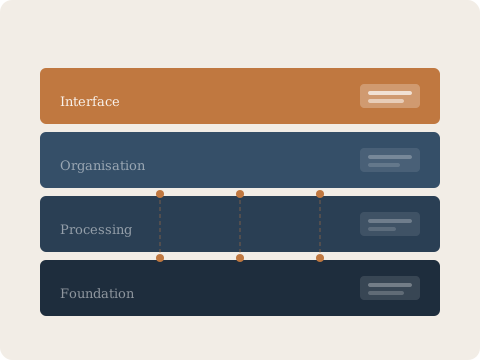
How Information Moves Through the Platform
Hearthvyn processes information in clearly separated layers. Each layer has a defined function, and the output of one layer becomes the input of the next.
Input and Reception
Information enters the system through the designated entry channels. At this stage, records are held as received — they carry their original form and have not yet been interpreted or classified.
The system records the time and source of each incoming item so that the provenance of classified material can be traced to its origin.
Classification and Labelling
Once received, each record is assessed against the classification framework configured for the system. Records are assigned to categories, tagged with relevant identifiers, and prepared for organised display.
The classification process is rule-based. The rules are defined within the system and can be reviewed in the system documentation available to authorised users.
Structured Presentation
Classified records are assembled into views designed for review. These views include grouped summaries, filtered lists, individual record displays, and navigable category trees — depending on the access level and configuration in use.
The presentation layer does not modify records. It organises and displays them. The original form of each record is preserved.
User Actions and Outputs
From within the interface, users can navigate between views, inspect individual records, apply additional filters, and, where permitted, initiate actions on specific items. The actions available are described within each view and do not exceed what the system has been configured to support.
Outputs from the system reflect the information it holds at the time of review. Users should note that the system cannot confirm whether the information it holds is complete with respect to external sources.
What Users Typically Ask Before Access
Hearthvyn is designed to work with structured and semi-structured information: records, categorised entries, labelled datasets, and documented items. The specific types it handles depend on how the system has been configured for a given deployment. General enquiries about supported information types can be directed to our support team.
The framework is established during system configuration. It specifies the categories, rules, and labelling conventions that the system applies to incoming records. The framework can be reviewed and adjusted by authorised administrators. The system documentation describes how to inspect the active framework and what changes are permitted at each access level.
The ability to modify records depends on the permissions associated with a user's access level. Some users have read-only access; others have the ability to reclassify, annotate, or act on records within defined boundaries. The permissions model is described in the system documentation, and any modifications are logged for traceability.
Before submitting an access request, it is useful to understand what kind of information you expect to review, at what level of detail, and for what purpose. This helps the support team match your request to the appropriate access level. Access decisions are made by the team and communicated directly. The team may ask clarifying questions before confirming or declining a request.
Hearthvyn organises and presents information; it does not independently verify the accuracy or completeness of the records it holds. The system reflects what has been entered into it. Users should take this into account when reviewing outputs and should not treat organised records as independently confirmed facts unless that verification has occurred through a separate process.
Hearthvyn presents information as it has been organised within the system. The service does not certify, endorse, or independently verify records on behalf of users. Where verification of specific information is required, users should consult the appropriate external sources directly.